Introduction
This article covers problems installing ƒh, and problems that stop it starting or running properly once it’s installed. For licence and activation problems see Family Historian Licence Problems and Family Historian Activation. For general advice see Family Historian Installation Advice and, if you’re moving to Version 8, Upgrading to Family Historian 8. Calico Pie’s own Frequently Asked Installation Questions are worth a look too. If you run ƒh on a Mac or Linux, see Family Historian on Mac, Linux, iOS, Android etc.
Before trying anything else, it’s worth checking these, because between them they fix a fair number of installation problems:
- Make sure ƒh isn’t running (look on the taskbar) before you install or upgrade.
- Right-click the installation file and choose Run as administrator. You may be asked for an administrator password.
- Turn off your anti-virus software while the installation runs, and turn it back on afterwards.
Most of the Windows steps below are in Start > Settings. A few older settings are still in Control Panel, which you can open by typing its name into the Start menu search box. Use an administrator account for all of them.
Windows Safe Mode
As a last resort, an installation can be run in Safe Mode, where Windows starts with only the essentials. Sign in to an administrator account, then click the Power button on the Start menu, hold down Shift and click Restart (or use Start > Settings > System > Recovery > Advanced startup > Restart now). In Choose an option select Troubleshoot > Advanced options > Startup Settings > Restart, and on the Startup Settings menu press F4 for Enable Safe Mode. When you’ve finished, restart the PC as normal.
Downloading the Installer
Browser and Windows Warnings
Browsers often warn about downloaded installers (“This type of file could harm your computer”, “The publisher couldn’t be verified”, or in Chrome “appears malicious”). For a file downloaded from the Calico PieCalico Pie Limited is a UK software house, and the publishers of Family Historian. website these can be ignored: choose Keep, Keep anyway or Run anyway. In Edge, a red cross may say the file is unsafe; click the three dots and choose Keep, then Keep anyway. If one browser refuses to keep the file, try another.

When you run the file, Windows SmartScreen may say it has protected your PC from an unrecognised app. Click More info and then Run anyway. If you get an Open File – Security Warning about an unknown publisher instead, right-click the downloaded file, choose Properties, and on the General tab click Unblock and then OK.
“This program does not support the version of Windows your computer is running”
There are two likely causes.
The download may be incomplete or damaged. Clear your browser’s cache and download the file again, or use a different browser:
- Edge: Settings > Privacy, search, and services > Clear browsing data, and tick only Cached images and files.
- Firefox: Menu > History > Clear Recent History, choose a time range and tick only Cache.
- Chrome: Menu > Delete browsing data, and tick only Cached images and files.
Or you may be installing Version 8 on 32-bit Windows. Version 8 needs a 64-bit version of Windows 10 or 11 (see Calico Pie’s system requirements). To check, use Start > Settings > System > About and look at System type. Versions 7 and earlier are 32-bit programs and run on either.
Windows Security Blocking ƒh
Windows Security has a feature called Controlled folder access that stops apps it doesn’t recognise from changing files in protected folders, including Documents, where ƒh keeps its projects by default. It can get in the way when you install ƒh or save a projectA Project is a Windows folder, created by Family Historian, which contains all your Family Tree information recorded in Family Historian. Normally located in the Documents\Family Historian Projects folder., especially from a non-administrator account. Windows may show a notification saying it has blocked ƒh, but the messages from ƒh itself don’t point to the cause. Those reported include:
- The system cannot find the file specified
- Failed to take a snapshot (when ƒh8 first opens a project from an earlier version)
- Failed to generate temporary file (when saving)
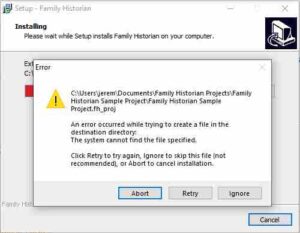
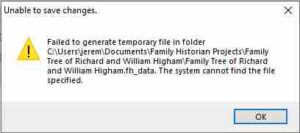
The fix is to let ƒh through. From an administrator account use Start > Settings > Privacy & security > Windows Security > Virus & threat protection, and under Ransomware protection select Manage ransomware protection. Then select Allow an app through Controlled folder access > Add an allowed app and browse to fh.exe. For Version 8 it’s in C:\Program Files\Family Historian 8\Program; for Versions 6 and 7 it’s in C:\Program Files (x86)\Family Historian\Program. (You can switch Controlled folder access off on the same page, but that removes the protection for everything.)
If the installation itself fails, Calico Pie recommend cancelling it, switching Controlled folder access off, and running the installation again. When it has finished, switch Controlled folder access back on and add ƒh as an allowed app.
Version 8 is a separate program from earlier versions, so if you allowed ƒh7 you need to add ƒh8 as well. If ƒh8 has already upgraded a project but can’t save it, close the project, allow ƒh8, and open it again; if it still won’t save, go back to the copy or backup you made before upgrading.
Microsoft Defender
Microsoft Defender, the anti-virus built into Windows Security, can occasionally block or quarantine ƒh files as well. Anything it has blocked is listed under Start > Settings > Privacy & security > Windows Security > Virus & threat protection > Protection history, where you can allow it. If it keeps happening, add the ƒh program folder (and, if need be, your projects folder) as an exclusion: on the same Virus & threat protection page, under Virus & threat protection settings, select Manage settings, then Add or remove exclusions > Add an exclusion > Folder.
Other Security Software
Anti-virus and internet security software can also stop ƒh working, sometimes with “Family Historian has stopped working” and sometimes with no message at all. McAfee, Bitdefender and BT’s security software have all done this: see The McAfee Saga – Family Historian disappears. Add ƒh to the software’s list of trusted or excluded programs; if that doesn’t help, uninstall the security software temporarily to see whether the problem goes away.
Errors While Installing
Error 126: DLL Missing, Corrupt or Wrong Version
The message names a .dll file, such as zlib.dll or, for Version 7 and earlier, mfc100.dll or msvcr100.dll. It means the Microsoft Visual C++ files that ƒh installs alongside itself are missing or damaged, often because an upgrade was installed while ƒh was still running. Close ƒh and run the installation file again. If that doesn’t work, contact Calico Pie (see Still Stuck? below).
ƒh Won’t Start, Crashes or Freezes
Crashes When Showing a Diagram
ƒh uses the default printer’s driver to lay out diagrams, so a faulty printer driver can make it crash, or report “Family Historian has stopped working”, whenever a diagram is shown. To test, go to Start > Settings > Bluetooth & devices > Printers & scanners, turn off Let Windows manage my default printer, and make Family Historian PDFThe Portable Document Format (PDF) is a file format developed by Adobe to present documents in their original formatting, independent of software, hardware, and operating systems. PDF files can contain text, graphics, links, and buttons, form fields, audio, video, and (x64) the default printer (Family Historian PDF for Version 7 and earlier). If the problem goes away, install the latest driver for your real printer from its maker’s website, then set it back as the default. Some Samsung printer drivers have been known to cause this.
In Version 8 you can also try the Cache Printer Settings option in Tools > Preferences > General > Advanced, which can help when a printer driver makes diagrams sluggish. See Advanced Preferences.
Starts, Then Nothing Happens, or the Display Misbehaves
If a busy icon appears for a second or so and then nothing happens, or windows and diagrams draw oddly or flicker, an out-of-date or faulty graphics driver may be to blame. Drivers supplied with the PC are often old, and some NVIDIA ones have caused exactly this. Install the latest driver from the maker of your graphics card or chip (NVIDIA, AMD or Intel) rather than relying on the one the PC came with; Device Manager > Display adapters tells you which you have.
“Family Historian has stopped working” (Versions 6 and 7)
With Version 7 and earlier, the message “Family Historian has stopped working. A problem caused the program to stop working correctly” can be caused by Windows’ Data Execution Prevention (DEP). To exclude ƒh from it:
- Use Start > Settings > System > About > Advanced system settings.
- On the Advanced tab, under Performance, click Settings, and open the Data Execution Prevention tab.
- Choose Turn on DEP for all programs and services except those I select, click Add and browse to
fh.exeinC:\Program Files (x86)\Family Historian\Program. - Click OK and restart the PC.
This doesn’t apply to Version 8: Windows won’t exclude 64-bit programs from DEP. If ƒh8 stops working, try the printer and security software sections above first.
Family Historian Not Responding
“Not Responding” may appear in the title bar while ƒh is busy, for example making a backup or a report. Give it time to finish.
If it happens at other times, IBM Security Trusteer Rapport has been known to cause it, and the only known cure is to uninstall Rapport. See FH Not Reponding.
Links, Buttons and Tabs Don’t Work
If ƒh runs but many links, icons, buttons and tabs don’t respond, check whether you use WindowBlinds, which has been reported to cause this. You should be able to exclude ƒh from WindowBlinds.
Out of Memory
This mainly affects Versions 6 and 7, which are 32-bit programs, and usually happens when you’re making heavy use of pictures. ƒh has to be closed (right-click its taskbar icon and choose Close window if necessary).
The message doesn’t usually mean the PC has run out of physical memory. It refers to the commit charge: the memory Windows has promised to programs, which can’t exceed RAM plus the page file. Disk space is far cheaper than RAM, so the best workaround is a larger page file:
- Right-click Start and choose System, then click Advanced system settings.
- On the Advanced tab, under Performance, click Settings.
- On the Advanced tab of Performance Options, under Virtual memory, click Change.
- Clear Automatically manage paging file size for all drives, choose Custom size, and enter sizes in MB. The recommended size shown at the bottom is a guide.
- Click Set, then OK, and restart the PC.
Changing how ƒh handles picture thumbnails may also help:
- In ƒh, use Tools > Preferences > General, click Advanced and set Thumbnail Images to Load When Needed.
- Delete the
Thumbcache.datfile in the project’s cache folder. For a project called Example that’sDocuments\Family Historian Projects\Example\Example.fh_data\Cache\.
See the Forum topics ’Out of Memory’ when adding photo’s., Out of memory warnings with 2 projects open and Unable to load object.
Save as PDF Not Working
Which PDF printer ƒh uses depends on the version:
- Version 8: Family Historian PDF (x64), or Windows’ own Microsoft Print to PDF on PCs with ARM processors.
- Versions 6 and 7: Family Historian PDF (a novaPDF printer).
If both Family Historian PDF and Family Historian PDF (x64) are listed among your printers, they aren’t the same; the first can be uninstalled once you’ve stopped using Version 7. See PDF File Support.
If the Save Diagram/Result Set/Report As > PDF File commands stop working, even though they worked before, the PDF printer may have been removed or damaged (a Windows update can do it), or the print spooler may have stopped. Try these in turn.
Check or Reinstall the PDF Printer
- Version 8: if Family Historian PDF (x64) is missing from your printers, contact Calico Pie (see Still Stuck? below). In the meantime, use Microsoft Print to PDF.
- Versions 6 and 7: use Start > Settings > Apps > Installed apps to uninstall Family Historian PDF (novaPDF…printer) if it’s there (not Family Historian itself), then install install_fhnovapdf7.7.400.exe.
Restart the Print Spooler
The Windows print spooler sometimes fails to start after a restart. Open Start > Settings > Bluetooth & devices > Printers & scanners, select the Family Historian PDF printer and run the troubleshooter, which will start the spooler if it isn’t running. Or type Services into the Start menu search box, open it, find Print Spooler, and if it isn’t running, right-click it and choose Start.
Use Microsoft Print to PDF
Windows’ own Microsoft Print to PDF printer can be used instead in the Print window for most PDF output. If it isn’t listed, it can be added as a Windows feature.
Still Stuck?
Ask on the Forum, or contact Calico Pie through their support ticket system. Either way, say which versions of ƒh and Windows you’re using, and give the exact wording of any message (a screenshotA screenshot is an image showing exactly what you are seeing on your PC screen. You can use the free Windows Snipping Tool / Windows Snip and Sketch; on a Mac use CMD Shift 4 to capture screen-shots; all are free tools. helps).